BSc thesis · Bocconi University · 2026 · Supervisor: Prof. Alessandro Pigati
Geometrically-Grounded Uncertainty Quantification for Foundational 3D Vision Models
Summary
Modern 3D foundation models reconstruct a scene in a single forward pass, but they give one answer with no measure of how much to trust it. This thesis gives one of them a distribution over the poses it predicts, and asks how far that distribution can be believed.
Abstract
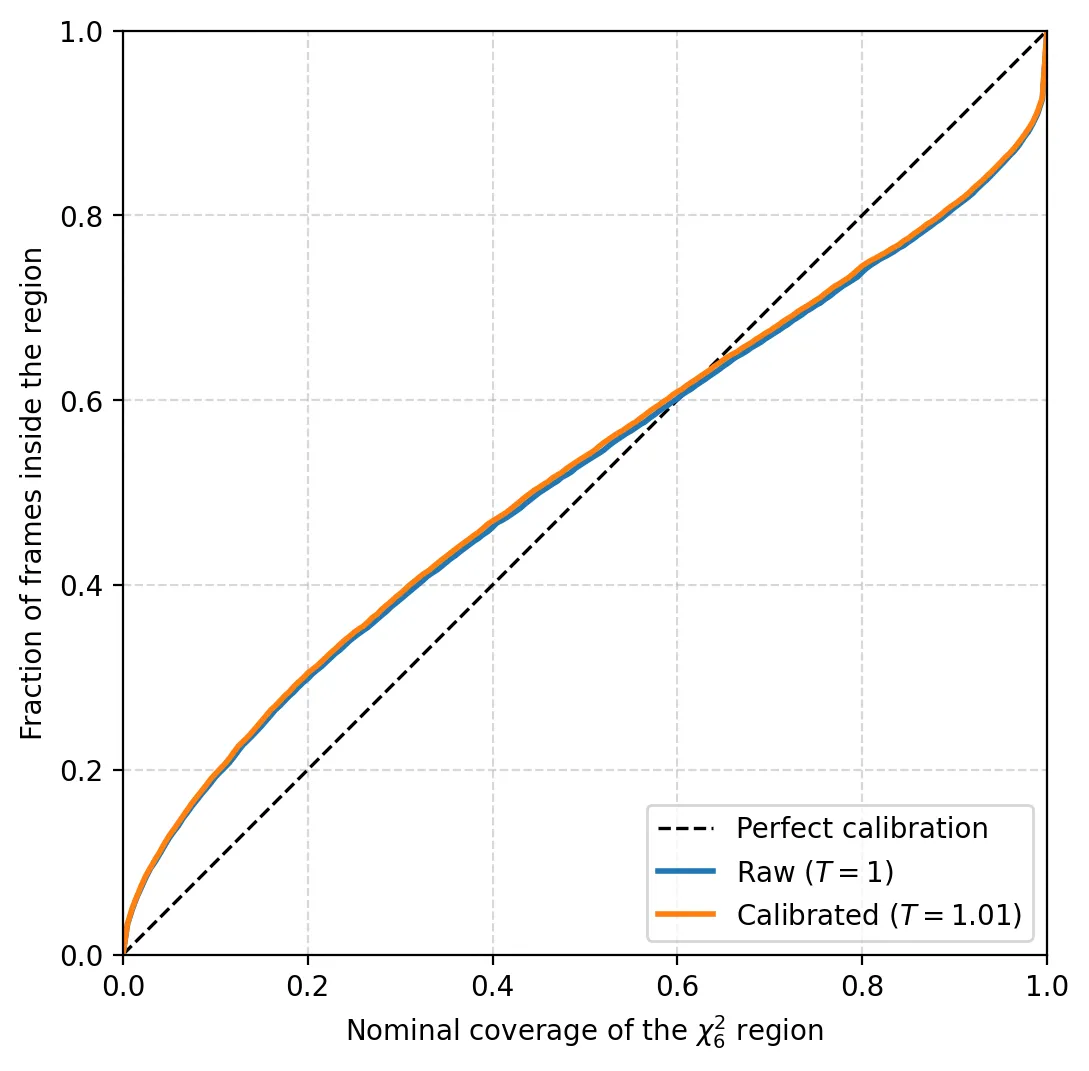
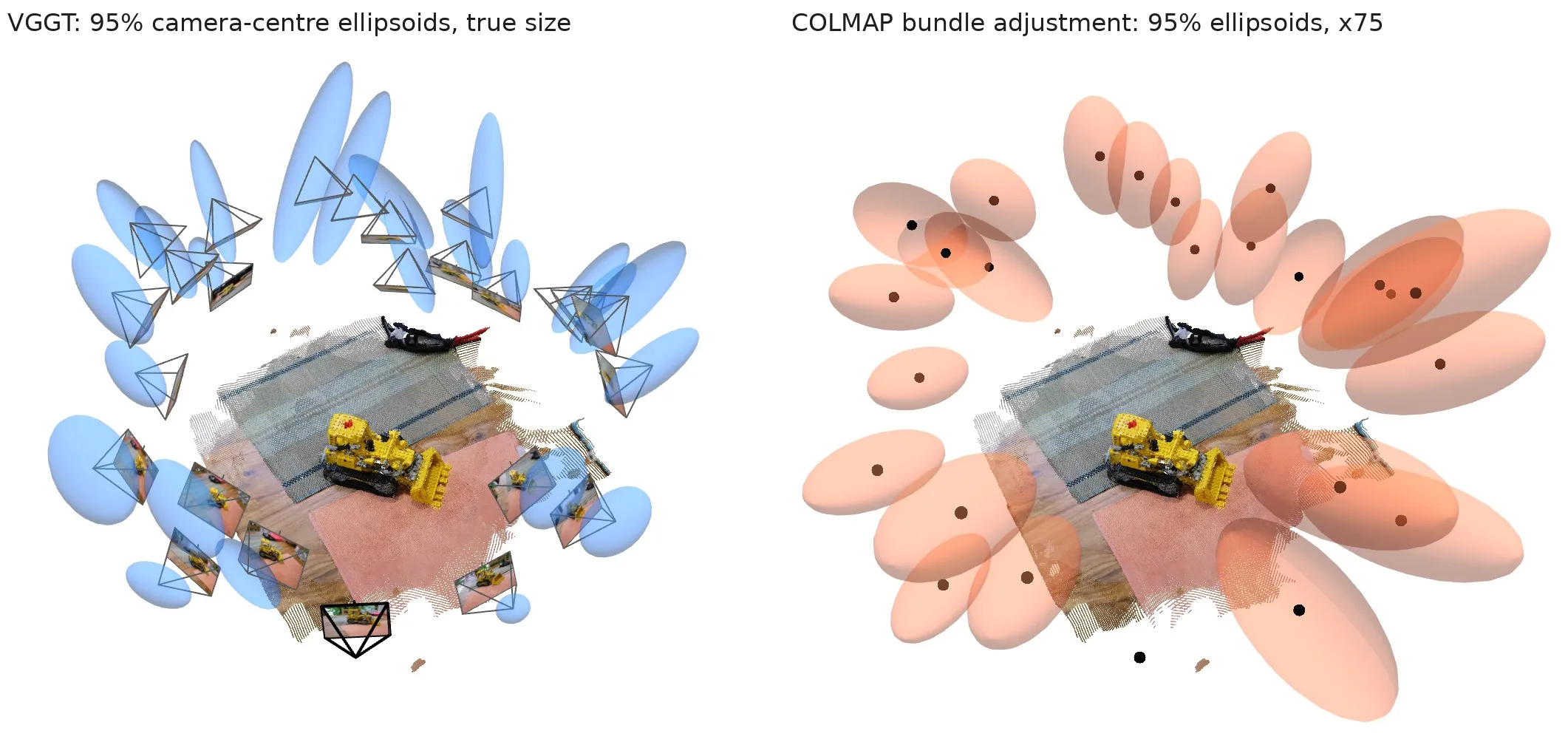
Foundation models for 3D vision such as VGGT predict camera poses without any measure of confidence, which makes them difficult to use wherever probabilistic reasoning matters, from sensor fusion to active vision. The thesis extends VGGT with a separate covariance branch that predicts a full camera-pose covariance, formulated rigorously on the manifold: a body-centric perturbation model on the Lie algebra , a left-invariant weighted metric reconciling translational and rotational units, trained with a curriculum for stability. The backbone and the mean-pose pathway stay frozen, so the point estimates of the base model are unchanged. On held-out CO3D sequences the predicted uncertainty ranks frames by their pose error and has the right scale on typical frames, though the errors are heavier-tailed than the Gaussian model assumes. Its structure matches the analytical covariance of bundle adjustment on example scenes. On dynamic EPIC-KITCHENS video the uncertainty is large across the whole reconstruction, correctly signalling that it is unreliable.
This is the revised version released in September 2026. Implementation errors in the original training and evaluation code were found while preparing the public release; they were corrected, the model was retrained, and every quantitative result and figure was recomputed with the released code.
Contributions
- A probabilistic extension of a foundation model. VGGT predicts a full distribution over camera poses instead of a single estimate, while its existing pose prediction is preserved exactly through a frozen pathway.
- A separate covariance head. A parallel lightweight branch conditioned on visual evidence and the solver’s internal state.
- Geometric rigour on Lie groups. Body-centric perturbations on , a weighted left-invariant Riemannian metric, and a negative log-likelihood with Cholesky-parameterized covariances.
- A stable training strategy. A curriculum that begins with regularization over scale, conditioning and balance, followed by fine-tuning on the negative log-likelihood, which prevents the covariances from collapsing.
Cite
@thesis{vanni2026geometric,
  author      = {Vanni, Leonardo},
  title       = {Geometrically-Grounded Uncertainty Quantification
                 for Foundational 3D Vision Models},
  school      = {Bocconi University},
  year        = {2026},
  type        = {BSc thesis},
  note        = {Supervisor: Alessandro Pigati}
}